US early voting: what turnout counts tell us
A national early-vote total does not tell us who is winning. Official county records show why the coverage and status of each dataset matter.
AP reported that more than 20 million Americans had voted early by October 22, with figures from 46 states. That is a participation snapshot, not a count of votes for candidates or a forecast of the result. [1]
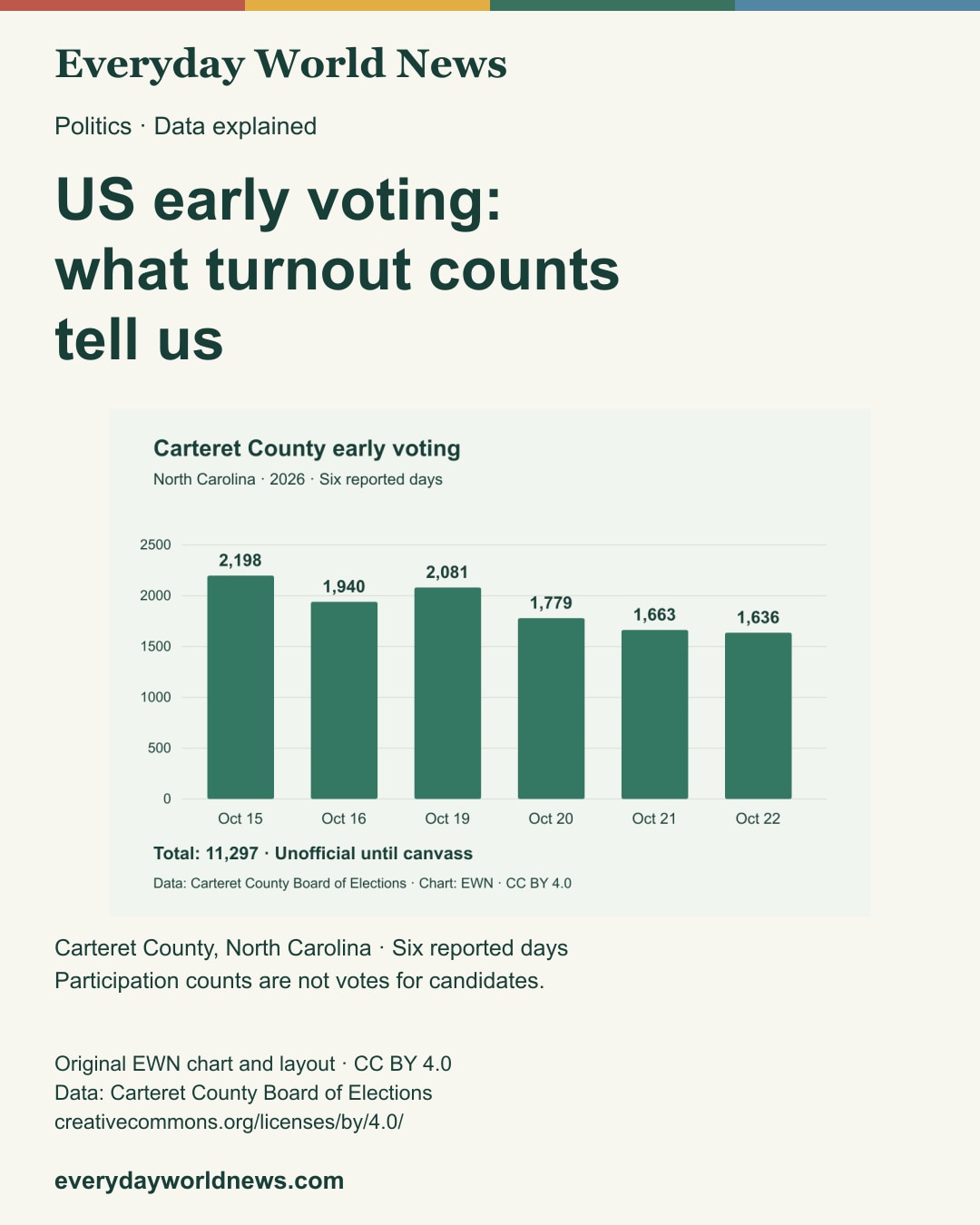
Local records illustrate what sits underneath such headlines. North Carolina’s Carteret County lists 11,297 early voters across six reported days through October 22. The daily figures are 2,198, 1,940, 2,081, 1,779, 1,663 and 1,636. EWN’s accompanying chart reproduces those counts without filling the gaps between reporting days. [2]
The county labels its numbers unofficial until canvass. Blank later rows therefore should not be read as zero turnout, and one county’s pattern cannot establish a national trend. The chart shows recorded participation in that local series, not party support. [2]
A separate official example shows why definitions matter. Nevada’s Clark County says its early-voting reports cover in-person participation, are normally uploaded the following day and remain unaudited, with clerical corrections possible. It explains that voters in its all-mail-ballot election can instead vote in person. Those files are not a complete count of every voting method. [3]
Before comparing two early-vote totals, check the geography, dates, voting methods and whether the counts are provisional. Different reporting windows or coverage can produce different numbers without a contradiction. None of these participation datasets identifies how the people counted voted; using them alone to declare a candidate ahead would go beyond the evidence. [2][3]
Carteret County early-voting chart
Sources & context · 3
- Associated Press — election live coverage
Live page’s displayed final update time. National snapshot attributed to AP; EWN did not independently recount all states. Full browser article read after text retrieval failed.
- Carteret County Board of Elections
Official 2026 daily table through October 22, inspected directly. No exact publication timestamp shown. EWN summed the six displayed totals; all are labelled unofficial until canvass.
- Clark County Election Department
Official description of its in-person early-voting series and reporting limits. Exact publication time not established. No individual voter file was downloaded or inspected.